The Gray Blending Consultation Question That Keeps You in Your Comfort Zone (And Still Gives Her What She Wants)
The Real Fear (And Why It's Valid)
You see those before-and-afters on Instagram - the 8-hour color corrections, the dramatic silver transformations, the complex formulas. And you think "I can't do THAT, so I can't offer gray blending."
But here's what nobody's telling you: Most women don't want that.
What they want is to stop stressing about their roots every three weeks. They want to feel pretty and current. They want their hair appointments to feel manageable, not like a part-time job.
And here's the secret: The consultation is where you find out which kind of gray blending client is sitting in your chair - and match her to what YOU can confidently deliver.
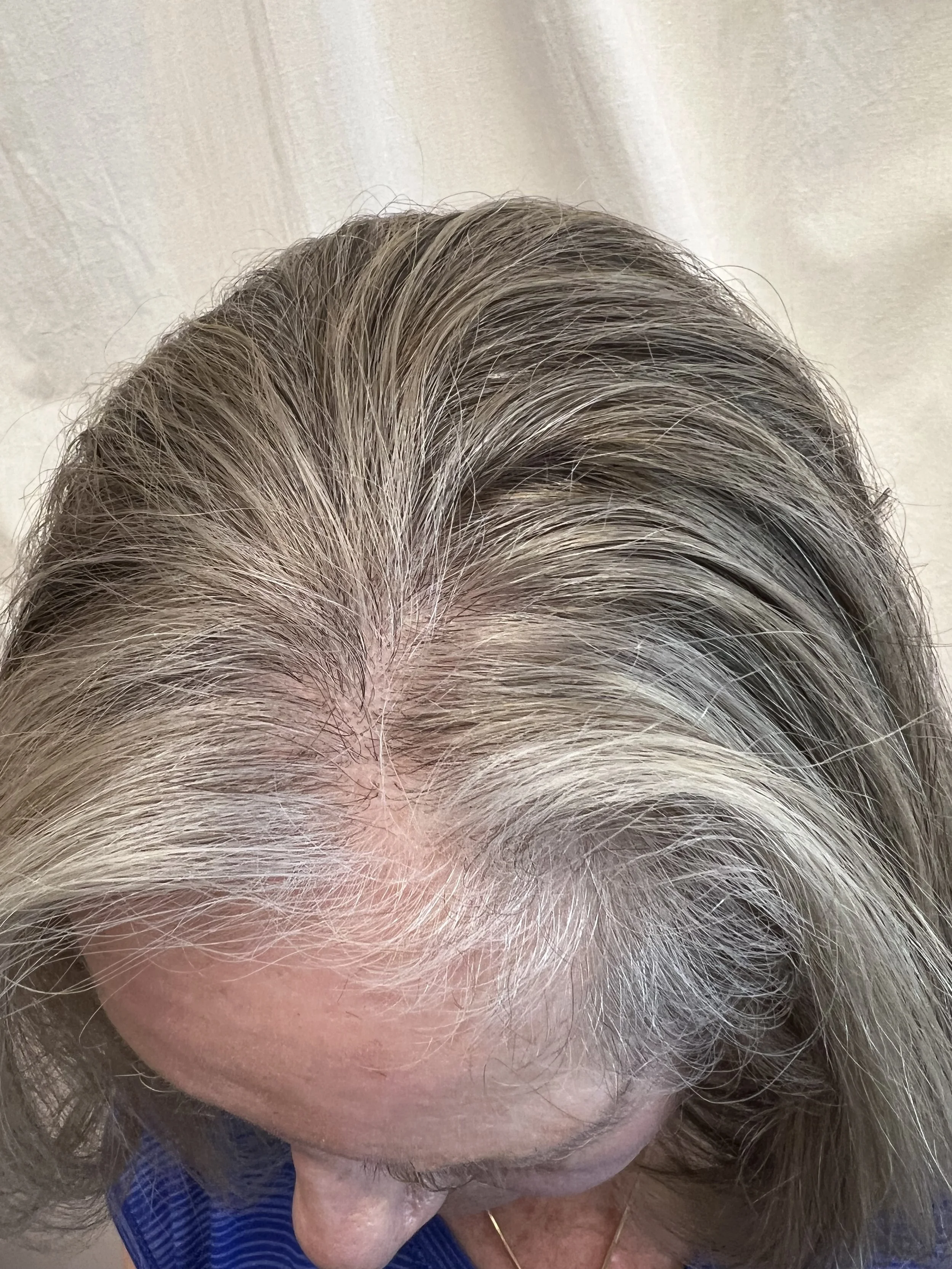
And honestly? I was relieved. Those all-day transformations were hard on my body. When you're doing multiple full-head lightener applications week after week, it takes a physical toll. I had to reduce how many I was doing.
But here's what I discovered: A high percentage of my clients didn't need or want the full transformation. They preferred to avoid the upkeep and damage. They chose enhanced natural gray blending - what some people call camouflage blending - where their gray looks intentional, dimensional, and beautiful, and that was absolutely within my comfort zone while still pushing me to learn new skills. I learned gray mapping. I learned strategic placement. I learned how to make gray the star instead of trying to erase it.
Those clients ended up happier, more loyal, and easier to maintain. And my body thanked me.
In every gray blending consultation, I ask some version of this:
"On a scale of 1-10, where 1 is 'I want to see every gray hair beautifully blended and dimensional' and 10 is 'I want to be full silver as fast as possible,' where do you fall?"
The Question That Changes Everything
This question reveals whether she's a:
Enhanced natural/camouflage client - wants her gray to look intentional and beautiful, not hidden or transformed
Gradual transition client - wants to go lighter over time, timeline is flexible
Full silver transformer - wants the dramatic change, higher complexity
And here's the part that will change your business: The majority want enhanced natural gray blending.
Why This Matters for Your Confidence
When you know she wants enhanced natural gray blending, you can confidently offer her techniques that work within your existing skill set:
Dimensional highlights and lowlights that are strategically placed for gray blending - and this is different from just doing highlights on gray hair. The placement matters. You're not randomly foiling - you're mapping based on where her gray is concentrated, her face shape, and how you want the grow-out to look. There's a specific pattern that makes gray look like an expensive balayage instead of roots that need touching up. (I teach the gray mapping strategy in my weekly emails - join here if you want to learn the placement patterns that actually work.)
Gradually lightening her base with demi-permanent color and adding strategic highlights over time to reduce the contrast between her natural gray and her colored hair. This lets her stretch appointments from every 3-4 weeks to every 8-12 weeks while her hair looks polished the entire time.
Root smudging or shadowing that softens the grow-out - 2-3 hour services that buy her time between appointments and make her roots feel manageable instead of glaring.
These techniques push you to learn new things - like strategic placement and gray-specific formulation - but they're not overwhelming. And they're definitely not all-day appointments.
The consultation revealed what she actually wants - and it's something you can deliver.
What I Learned the Hard Way
Here's my truth: I started my gray blending business jumping into big transformations. Full silver. Fast timelines. All-day appointments.
And yes, they were beautiful. But as I got busier and more booked with gray blending clients, I started to notice something: Not everyone actually wanted those intense transformations once they understood what they involved.
The reality is that full-day transformations using lightener come with trade-offs:
Frequent toner maintenance - toners fade, sometimes quickly, which means coming back every 3-4 weeks just to keep the tone right
Different hair care routines - their hair will need more moisture, different products, gentler styling
Damage is real - no matter how carefully I work or how much I prioritize integrity, lightener is a damaging process. That's just the nature of it.
I'm truthful with clients about this. And you know what happens? A lot of them choose enhanced natural gray blending instead. They say, "Actually, I don't want to deal with all that. I want my gray to look beautiful, not gone."
And honestly? I was relieved. Those all-day transformations were hard on my body. When you're doing multiple full-head lightener applications week after week, it takes a physical toll. I had to reduce how many I was doing.
But here's what I discovered: A high percentage of my clients didn't need or want the full transformation. They preferred to avoid the upkeep and damage. They chose enhanced natural gray blending - what some people call camouflage blending - where their gray looks intentional, dimensional, and beautiful.
And that was absolutely within my comfort zone while still pushing me to learn new skills. I learned gray mapping. I learned strategic placement. I learned how to make gray the star instead of trying to erase it.
Those clients ended up happier, more loyal, and easier to maintain. And my body thanked me.
What the Consultation Tells You About Execution
Once you know she wants enhanced natural gray blending, the consultation gives you the rest of the technical roadmap:
Ask: "How do you feel about your current color?"
If she likes it: You're adding dimension to blend her gray in, not changing her base
If she's tired of it: You can start lightening her base and letting her natural grow in
Ask: "How often do you want to be here?"
Every 4-6 weeks: Root smudge or shadow that extends her color
Every 8-12 weeks: Strategic highlights that grow out beautifully
As little as possible: You'll need to talk about what that really means for upkeep
Ask: "How do you feel about changing your hair care routine or dealing with potential dryness?"
Strong no: Enhanced natural blending is her answer
Open to it: You can discuss transformation options honestly
See what just happened? She told you which technique to use, what your timeline is, and what she can handle. You're not guessing anymore.
(I break down the complete consultation question bank and how to match answers to techniques in my emails - join the list here for the full framework.)
The Difference Between Highlights and Gray Blending Highlights
Here's something valuable: Highlights for gray blending are not the same as highlights on someone who's covering their gray.
When you're doing highlights on someone who colors their gray, you're adding lightness and dimension to colored hair. Pretty straightforward.
But when you're doing highlights for gray blending, you're strategically placing them to:
Break up the line of demarcation between colored hair and natural gray
Create a pattern that makes the gray look like it belongs there
Ensure the grow-out looks intentional, not neglected
Blend the different textures and tones of gray into the overall color story
The placement has to be smart. You need to know where her gray is concentrated, how it grows, and how to make it look like expensive dimensional color instead of roots.
It's easy to learn once you know what you're looking for - but it makes all the difference between "she's growing out her color" and "that's a gorgeous silver blend."
The Permission You Need
If a client says she wants to be full silver in 6 months and you're not confident doing that level of transformation yet - or you know it's not the right fit for her hair?
You can say: "That's a beautiful goal. I want to be honest with you about what that involves - we'd be using lightener, which means your hair will need different care and regular toner maintenance. If you're open to that, we can talk about it.
But what I'm really skilled at is enhanced natural gray blending that keeps your hair healthy while making your gray look intentional and beautiful. Most of my clients end up preferring that once they understand the trade-offs. Which sounds better to you?"
That's not a weakness. That's integrity.
And honestly? Most will choose the gentler path once they know damage and upkeep are part of the transformation package.
What This Means for Your Business
When you frame your gray blending consultations around discovering what they ACTUALLY want (not what Instagram tells them to want), you will find:
70-80% want the enhanced natural approach you can deliver confidently
Your appointments stay manageable (2-4 hours, not all day)
Your body doesn't take the beating that all-day services cause
Your clients are happier because you set realistic expectations
You learn new skills that challenge you without overwhelming you
You can raise prices because you're solving a real problem
The consultation is the tool that lets you build your gray blending business within your current comfort zone while still genuinely serving clients.
The Truth About My Business
I built a thriving gray blending business once I stopped trying to be the transformation specialist for everyone and started being the relationship specialist who helps clients make educated decisions that work for their lives.
My clients are loyal. They refer. They tip well. They trust me with their vulnerable moments.
Because I asked the right questions, gave them what they actually wanted, and delivered it with honesty.
That's all gray blending has to be.
Want the Complete Consultation Framework?
In my emails, I share:
The complete question bank for gray blending consultations - assessment, lifestyle, expectations, hair health reality checks
How to match client answers to specific techniques and services
The gray mapping strategy for dimensional highlights and lowlights that actually blend
The difference between regular highlights and gray blending highlights - and how to place them strategically
How to transition clients from full color to strategic highlights without the patchy in-between stage
Honest scripts for talking about damage, upkeep, and reality without scaring clients away
The pricing conversation that communicates value without apology
Real client scenarios and how I navigated them
Plus, when you join my list, you'll get my Gray Blending Client Assessment Worksheet - a simple tool you can use in every consultation to gather the information that makes execution feel clear instead of scary.
This is for stylists who want to grow their gray blending business by being honest, skilled, and genuinely helpful.
[Join The Silver Coach email list here - it's free, and you can unsubscribe anytime]